21 Nov 2026
Sixty years on, The same house
by Master Giuseppe Lanotte
It always begins at the same instant: when the wheels of the plane touch the tarmac and the fuselage shudders for one long second before slowing down. Anyone who loves this art knows what I mean, even if, once you try to line it up in words, you risk sounding rhetorical. Vienna is a beautiful city, of course, set there at the centre of Europe with all its history resting on the fronts of its buildings. But inside that great history there is a page that concerns us, the people of ITF Taekwon-Do. I land, I think of it, and before I have even collected my suitcase I feel a small grip right in the middle of my chest.
This time, though, there was something else inside that grip. In the weeks before I left, my phone had not stopped buzzing: messages, rumours bouncing from one chat to another, hardly ever with a name underneath. In the end they all said the same thing: that the house was no longer what it used to be. I answered none of them. I put that question in my suitcase, next to my dobok, and I left.
I’m a lawyer. It is a job that teaches you to distrust easy emotions and to take shelter in facts, in dates, in the documents on file. So, while the taxi glides towards the centre, I do what I always do when I need to put my thoughts back in order: I line up the chronology.
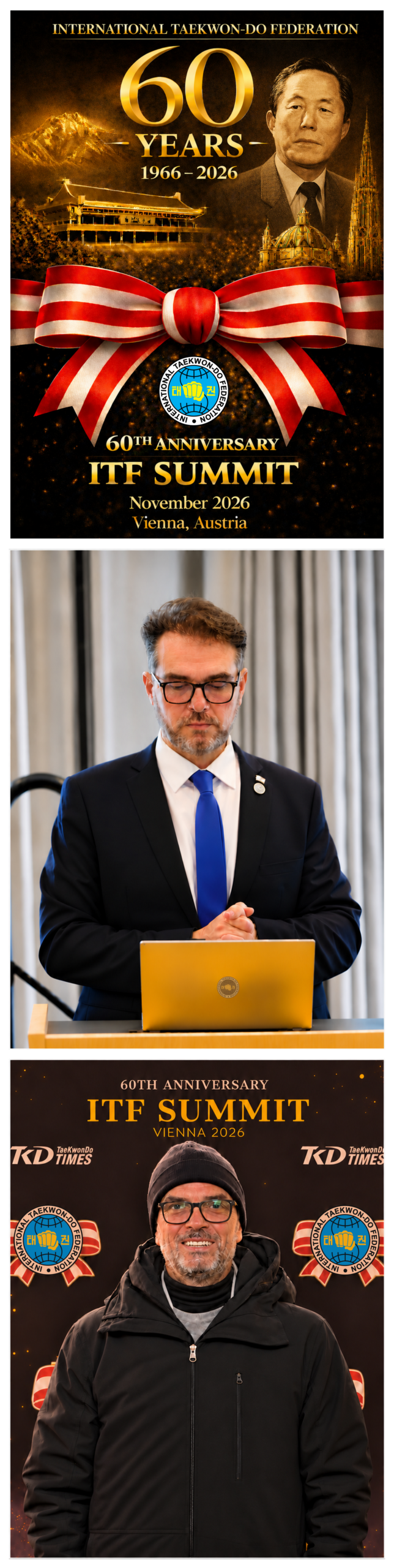
Seoul, 22 March 1966. General Choi Hong Hi, who eleven years earlier had given Taekwon-Do its name, founds the International Taekwon-Do Federation. Around him are the representatives of nine national associations: Vietnam, Malaysia, Singapore, West Germany, the United States, Turkey, Italy, Egypt and Korea. Mine is there among them. Nine different flags and a single idea, simple and ambitious like the ideas that outlast time: that Taekwon-Do should belong to the whole world.
Then came Toronto. Then, in 1985, Vienna. Here the General worked, here he taught and held his Dan examinations, here he welcomed men and women who had crossed half the planet only to learn from him. The Founder is no longer with us, as is the nature of things. The house, though, is still in its place. And its door has never been locked.
There are stories that survive in books, and others that stay lodged in the walls of places. This November, about three hundred of us came back to this very place.
We came from forty-three countries. In the corridors and halls, Grand Masters with the marks of time on their hands, men who had looked the Founder in the eye, crossed paths with very young athletes who know him only through the voices of their teachers. There were instructors, umpires, leaders of the national federations. Different languages, different passports, the same salute.
In the morning we moved away from the Headquarters, to a sports hall in the city. Within minutes the floor had disappeared under the white of the doboks. Grand Master Hwang Ho Yong took instructors and umpires by the hand and led them into the patterns, one movement after another, with the exact patience of someone who knows the weight of a millimetre. I thought about it as I watched him: an instructor studies a movement in order to pass it on; an umpire studies the same movement in order to judge it fairly. Instructors and umpires have much in common, though they rarely get the chance to compare notes. In Vienna, for once, they studied it side by side, to the same count in Korean. And for a few hours sixty years folded until they seemed a single instant.
On Friday evening we met at the Grand Hotel Wien, on the Ringstrasse, the great boulevard that embraces the old centre, a few steps from the State Opera. It is a hotel that opened its doors in 1870 and has watched a century and a half of Viennese history go by: nineteenth-century salons, the kind where you would expect a string quartet. Instead, that evening, into all that elegance walked the Greek national team, and staged patterns, sparring and power breaking. There was something right in the pairing: an art born in Korea, perfectly at ease in the ballroom of the Grand Hotel. As if Vienna, once again, were telling us that we are at home there.
On Saturday, instead, the doboks stayed in the bags. We put on the official uniform and gathered in the garden of the Headquarters. You could tell at once who was returning to a place he knew by heart, from the easy way he moved along the paths. The others, those crossing the threshold for the first time, looked around slowly, with that slightly suspended silence that comes over you when you finally see in person a house you have heard about all your life.
The garden was dressed for a celebration. There were lights everywhere and, here and there, open fires, and little by little we gathered around them in small groups. Meanwhile someone was preparing the local specialities right there, on the spot, and handing them to us still steaming. We ate standing up, close to the fire, and we talked. It is hard to explain what it meant, for one of us, to be in that garden on an evening like that.
Then, without anyone having planned a programme or switched on a microphone, the stories began. Masters and Grand Masters pointed to the training hall beneath the offices, or to a precise corner of the garden, and said: here I took my Dan examination in front of the General; here we trained under his eye; here we walked at his side. The younger ones listened without interrupting. Nobody was directing it. It was the house itself that made them speak.
Standing there in front of the fire, I remembered the question in my suitcase. And I thought that a house which is no longer what it used to be does not make people speak like that.
A house, however, does not stand on memories alone. Memories warm the rooms, but without clear rules, accounts in order and someone who answers when you knock, sooner or later the roof gives way. So on Sunday the doboks stayed folded, and instructors and national representatives sat down around the tables to talk about competition rules, technology, and how the Federation will be governed and funded from 2027.
I listened. But as the explanations flowed one after another, my head did what it often does in meetings that run too long: it left the room and took the road home.
I found myself in my own hall, on an ordinary weekday evening. The lesson has just ended, there is that familiar smell of clean effort in the air, the children are folding their belts with still-clumsy hands and the parents are waiting by the door with their coats on. Sooner or later, I told myself, everything they are explaining in Vienna I will have to tell them. And so, in the silence of my mind, I began to rehearse.
The first to approach is a mother. Her son tied on his white belt barely a month ago. “Why,” she asks me, “does he have to be affiliated already?”
In my little mental theatre I walk to the shelf, take down the Encyclopedia that General Choi left us and open it at the page of the belts. There they are, in a row, the whole path that awaits a student. The white belt is there too, on the first step: the colour of someone who knows nothing yet and has everything to learn ahead of him. It does not stand outside the road, I tell her. It is the exact point where the road begins, and from that day your son is part of the family. The Federation’s Constitution has provided for it for years: every practitioner enters the register from 10th Gup. Because a family calls its children by name from the first day; it does not wait for them to become champions before remembering them.
A little further off there is a father who has listened to everything with his arms folded, with that clear-eyed wariness that today is almost a duty. “And my daughter’s data,” he asks, “where do they end up?”
They remain yours, I answer. Neither the club nor the Federation becomes their owner. The ITF answers for the register under European data protection law; the central servers are in Strasbourg, in France, and only authorised people who strictly need them for their work can access them. This very evening, from home, you can open her profile, decide whether to make it visible or keep it private, have a mistake corrected, ask for a copy or, in the cases provided by law, for erasure. If one day you move to another city, her history will come with her. And nobody in a club — not even I — can alter a grade or erase a child’s past. And if you would rather ask someone other than me, in Vienna there is a person whose only job is this: to protect members’ data, and to answer those who write.
Then, inevitably, comes the question every parent has every right to ask, and that almost nobody asks out loud, out of a kind of reserve. So I answer it myself, without waiting for someone to break the ice. For a child with a coloured belt, the annual contribution works out at one euro a month. For a black belt, it’s two euros. Think of a small bottle of water a month, I tell them, or two for a black belt. At some cafés in the EU, in Vienna for example, even two euros won’t buy you one. From January, when your child earns an ITF Degree, there will be no separate fee for issuing the certificate anymore. Only the local grading fee will apply. If your son stops for a year — because school gets heavy, or because life takes its turns — he pays nothing and loses nothing: his place stays there waiting for him. As for that large figure you may have read about here and there, it does not concern you and it does not concern a club like ours. It is an advance that the recognised governing bodies pay on their own members’ contributions. If one of these bodies finds itself in difficulty, there is a Solidarity Programme. And if a body should fail in its commitments, the children do not pay for the faults of the adults: the belts they have earned remain theirs.
From the back of the group a more cautious voice comes forward. “And if things go wrong?”
That is above all what rules are for, I say. When things go wrong there must be a door to knock on. If a student is refused registration, or if a governing body puts its members or their data at risk, Vienna can step in and look after those people directly; and that body, in turn, has the right to ask for a review and to go before the Austrian courts. And if one day the Federation decided to carry out a check on our club, it could ask only for what concerns the check: lists, grading records, certificates, receipts. Not our passwords, not our private letters, not our computers. Because between transparency and intrusion there is a precise line, and it must be respected.
Last of all there remains one of my athletes, with the doubt athletes always carry with them. A medal won at someone else’s tournament stays in the records of whoever organised it, I explain; but to enter the ITF rankings a result must come from the official calendar, and before entering an outside event you ask Vienna. As for ranks earned elsewhere, they are not thrown away: they can be presented, verified and recognised.
My hall empties, the lights go out, and I open my eyes again. I am back in Vienna, in a conference room, and from the speakers’ table someone is still talking about articles and deadlines.
Then we talked about change, and we did it in a sincere and open discussion, the way a real family does. People spoke from England, from Argentina, from Malaysia, and we talked about everything. We also talked about the Austrian tax audit, which lasted eighteen months. And that is where the lawyer in me came back.
I began to reason, to understand what had really happened. At home, in Italy, we reason in terms of prevalence: a non-profit body may also carry out commercial activities, provided they do not become its main activity. And how does it work in Austria? I understood that the test there is different, and stricter. Aside of the overall weight, it looks at the nature of each single activity. Membership fees, and whatever directly serves the purpose, stay outside taxation. The rest does not. And above a certain threshold, the activities that do not serve the purpose put at risk the tax classification of the whole association. Not of a part of its income streams anymore: all of it.
At that point the facts lined up by themselves. The ITF came through that audit with its head held high and retained its status as a non-profit association. But for the four years under review the authorities treated the former funding model as commercial, withdrew the related tax relief, and the Federation paid the tax due.
I understood clearly, then, why the Federation has to change course and change the way we funded our work if we wanted to preserve our charitable tax treatment in Austria. If it carried on under the old model, it would end up losing its nature as a non-profit body, and with it everything that follows from that. That is why we have to change. And that is what the Executive Board did in September 2026, when it approved the new model: no more ordinary certificate fees, and a Federation that stands on the annual contributions of its members.
Because the ITF does not exist to make profits. It lives on what we entrust to it, we who train and teach, and on the support of the national federations that guarantee it a stable contribution, year after year. Seen from this angle, the matter becomes almost elementary. It is right this way. And the reform does not move Vienna away from our halls: it does exactly the opposite. From the white belt to the Grand Master, each of us is today a little closer to the ITF.
Of course, none of this moves you as much as a garden full of friends meeting again. But it is exactly what allows that garden to stay open.
In the end it was my turn to take the floor as well. I spoke of our origins and of our identity: where we come from, the name and the emblem we wear stitched on us, and why they are worth defending. But when I reached the last line, I set the solemn speeches aside and closed with the simplest thing I had to say: the ITF is always there, with its doors open to everyone.
On Sunday evening, with the last session over, we sat down together for the gala dinner. Old friends and people who had shaken hands for the first time only forty-eight hours earlier, mixed at the same tables. I like to think that those who came to Vienna for the first time left carrying a quiet certainty in their pocket: that of knowing they will always be welcome here.
At some point during the dinner I realised that the grip in my chest had gone. The question I had left home with had been answered, and no speaker had answered it. A garden had, and a training hall beneath the offices, and three hundred people making the same salute. The house is the one it has always been. It has simply put its papers in order, as people do when they intend to stay.
Sixty years after Seoul, we continue the Founder’s work together. We will defend the Federation’s name, its emblem and the good name of the people who belong to it. And the door that General Choi opened in Vienna remains wide open, in a spirit of friendship, dialogue and peace.
The road goes on. It is the same road, in the same house.